
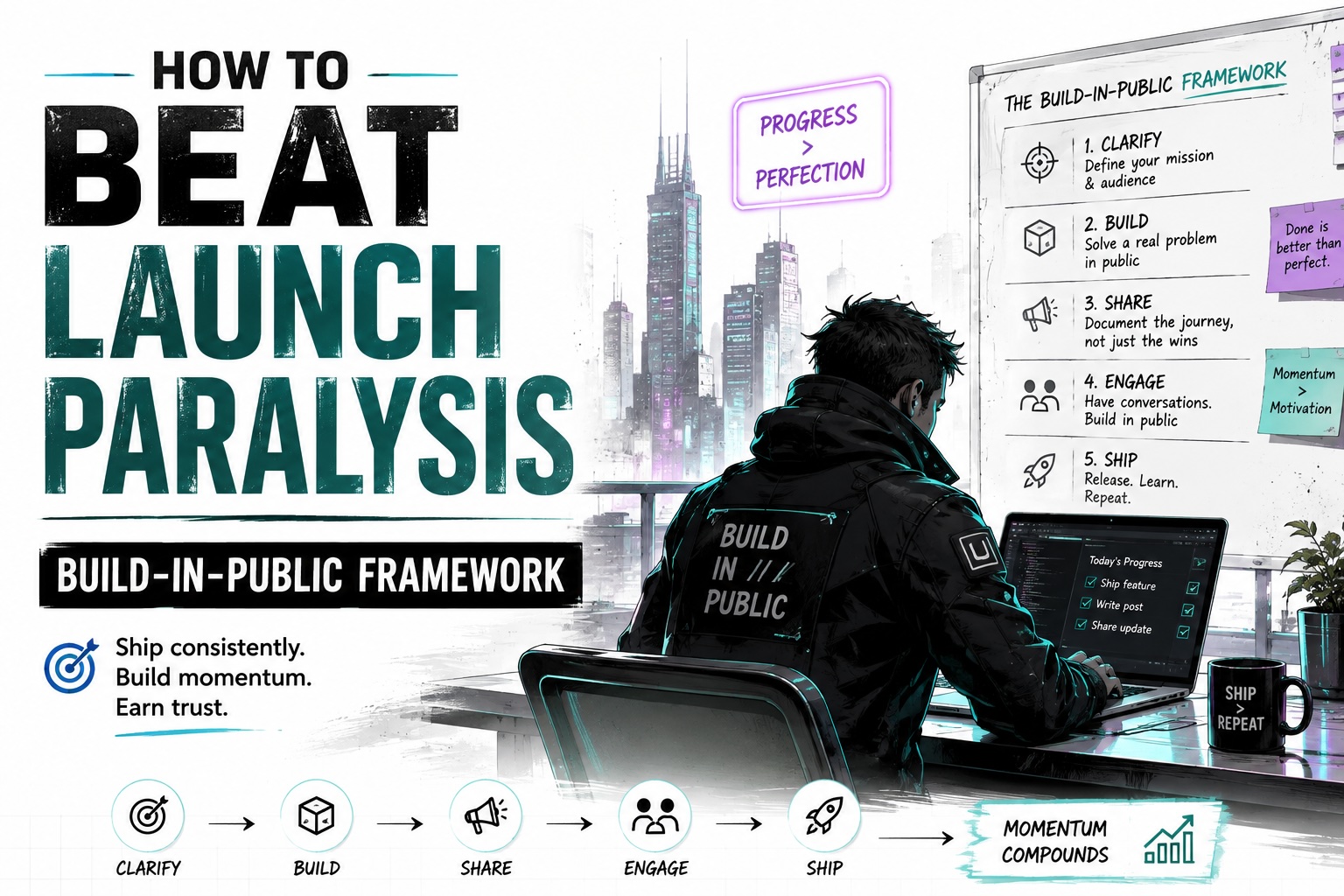
How to Beat Launch Paralysis: Build-in-Public Framework
The Code is Safe. The Market is Terrifying.
You just spent your entire weekend refactoring a helper class. The code is beautiful. It uses the latest design patterns, has ninety percent test coverage, and runs perfectly on your local machine. You tell yourself that this rewrite was essential before showing the application to real users.
It was not.
You are hiding. I know this because I spent years doing the exact same thing (and honestly, it’s the easiest trap to fall into). We swap out database drivers, tweak CSS margins, and rewrite working modules because the code editor is comfortable. Inside your IDE, errors are logical. You fix the syntax, the compiler turns green, and you feel a sense of accomplishment.
But the market does not care about your elegant architecture.
This escape behavior is called launch paralysis. It is a quiet, venomous anxiety that affects engineers transitioning from comfortable corporate roles to the chaotic world of indie hacking. In your day job, you get paid to write clean, maintainable systems. In the wild, nobody pays you for clean code. They pay you to solve their painful problems.
Let that sink in. Perfect software that sits on localhost is not a business; it is just a very expensive, highly complex hobby. The real world is messy, unpredictable, and entirely indifferent to your clean code. Until you push that local build to production, your business does not exist.
Why Developers Suffer from Launch Paralysis
Most software engineers are trained to build for scale. We are taught to think about high availability, load balancing, and microservices before we even have our first database record. When you start an indie project, this training becomes a heavy anchor. You spend weeks setting up Kubernetes clusters and automated CI/CD pipelines for an application that has zero visitors.
This is the perfectionism trap. We build infrastructure for millions of users to avoid facing the reality that we do not have a single customer. It feels like real work, but it is actually a form of procrastination.
We also hide in tutorial hell—continuously learning new frameworks under the guise of preparation—while adding endless features to our backlog. Feature creep is your subconscious mind building a protective wall. If your tool does not have every edge-case feature, you can blame its failure on completeness rather than demand.
To break this loop, you must change your operating system. Shift your perspective from output to outcomes.
In a standard engineering job, you measure success by lines of code written or tasks closed. As a founder, your only metric of success is validated learning. Did a real human open your application, use it, and experience a micro-moment of value? If they did not, your sprint was a failure—no matter how many pull requests you merged.
The Build in Public Cure
Building in public is not about bragging on social media. It is a brutal, effective forcing function designed to keep you honest. When you work in complete isolation, it is easy to let your deadlines slip. A week turns into a month, and a month turns into a year, because nobody is watching.
Sharing your development log openly kills this isolation. It changes how you view your launch. Instead of preparing for one massive, terrifying “Launch Day” where the sky might fall, you reveal your system in small, digestible pieces.
Shipping MVP as developer becomes significantly easier when you normalize showing your unfinished work. You stop treating your product like a precious, delicate masterpiece that must be shielded from the sun. Instead, it becomes a dynamic, iterative tool that evolves alongside your community.
This practice builds trust before you even launch a pricing page. People love seeing how things are made (especially the ugly parts). They want to see the database migration errors, the CSS bugs, and the clever workarounds. When you eventually ask them to open their wallets, they will not feel like they are buying software from a faceless entity. They will feel like they are supporting a peer who has taken them on a journey.
The 4-Step Framework to Ship Before You’re Ready
You do not need a massive budget or a marketing agency to break out of your local environment. You need a systematic, repeatable framework that forces you to deploy. This approach prioritizes speed and raw feedback over polish.
This is about low-cost, high-leverage execution. We are going to strip your product down to its absolute bare chassis, construct a simple spotlight, and push it out of the hangar doors before you can talk yourself out of it.
Let us begin with the knife.
Step 1: Define Your ‘Embarrassingly Simple’ MVP
Take your current list of features and cut eighty percent of them. No, that is not a typo. Look at the remaining twenty percent and slice that in half again.
Your MVP should do exactly one thing incredibly well. If you are building a social media scheduler, your tool should simply take a block of text and send it to one platform at a specific hour. You do not need automated queue optimization, image generation, multi-account workspaces, or advanced analytics.
Ban these technical distractions from your initial codebase:
- Complex multi-tenant billing models.
- Custom UI design languages.
- Elasticsearch integrations.
- Social login integrations with ten different providers.
Use simple, boring stack choices. If you know Rails, use Rails. If you know PHP, use PHP. Your goal is to construct a direct pipeline from your database to a user’s web browser as quickly as humanly possible.
Step 2: Establish a Daily Public Log
Select one single channel where you will document your progress. It could be X, LinkedIn, or a dedicated indie developer community. Do not overcomplicate this step by setting up a custom blog engine—use an existing platform where your potential audience already spends time.
Every single day, post one update. Show screenshots of your work-in-progress UI, paste a complex SQL query you optimized, or share a video of a bug that made you laugh.
Do not sanitize your progress. If your UI looks like it was built in 1998, post it anyway. Raw transparency is far more engaging than a polished corporate marketing update. People connect with the struggle, not the press release. Your daily update is the signal that you are active, building, and accountable to your promise.
Step 3: Collect Feedback, Not Compliments
When you share your work, people will occasionally say, “This looks neat!” Or, “Great job, keep going!”
Ignore those compliments. They are polite lies that will kill your business.
Instead, look for real behavioral signs. You are looking for people who ask specific questions about how your tool works, or those who ask to try your early build. When someone shows interest, send them a direct message immediately. This is where cold outreach shifts from a scary marketing tactic to a casual, high-value conversation between builders.
Ask these early onlookers to break your soft-launched application. Watch where they click, listen to their frustrations, and watch how they attempt to solve their problems. Use this unfiltered qualitative feedback to guide your remaining development cycle, rather than guessing what they want from your ivory tower.
Step 4: Pull the Trigger on Your Hard Deadline
Pick a date exactly three weeks from today. Write that date on a physical sticky note and place it directly on your monitor.
Then, write a public commitment post stating that you will drop the invitation link on that exact day. Tell your audience that anyone can come in and use the core feature, bugs and all. By doing this, you have burned your ships. The embarrassment of missing a public date is a far stronger motivator than any self-imposed sprint schedule.
Remember that the real indie hacker journey does not end when you deploy. That is the exact moment it actually begins. Your launch is not a final destination—it is simply the creation of a direct channel between your code and the market.
Overcoming the Psychological Roadblocks to Shipping
When you finally post your link, you might expect a torrent of criticism. You might worry that experienced developers will look at your page source and laugh at your unminified CSS.
Here is the truth: you can separate the chaff from the wheat, learn from valuable feedback or ignore the trolls.
In fact, the absolute worst-case scenario isn’t harsh criticism. It is complete silence. Public indifference is far more common, and it hurts your pride more than a negative review. You must prepare yourself for this quiet reaction.
If you launch to crickets, do not take it as a personal failure. Treat your deployment like a technical experiment. In your development environment, a failing test is just a data point telling you where the logic broke. Apply that same cold, objective perspective to your business. If your launch gets zero signups, your market test failed to spark interest. Adjust your variables, change your messaging, and run the test again.
You must shed your identity as a perfect, protective engineer and step into the shoes of a pragmatic founder. A pragmatic founder understands that a dirty, functional solution in production is infinitely more valuable than a perfect, unseen repository on GitHub.
Stop Refactoring. Go Live.
Your database schema is fine. Your buttons do not need another hover effect (seriously, your users won’t notice). Your code is ready, even if your mind is telling you it needs another week of polish.
The market is waiting for a solution, not an architectural masterpiece. Every day you spend refactoring clean code is another day you are actively delaying your growth as a business owner.
Close your split-editor view. Complain to your community about how hard it is to configure webhooks, drop your raw link, and let your users click around.
What is the single most bloated feature you are chopping off your roadmap tonight to force a deployment? Let’s talk layout in the comments below.
PS: I have been building Udeha.com to address problems such as this. I plan on launching it around mid-August 2026.